> ## Documentation Index
> Fetch the complete documentation index at: https://wiki.another-horizon.eu/llms.txt
> Use this file to discover all available pages before exploring further.
# Contextual menu
> Add one-click AI integrations to your docs.
export const PreviewButton = ({children, href}) => {
return
{children}
;
};
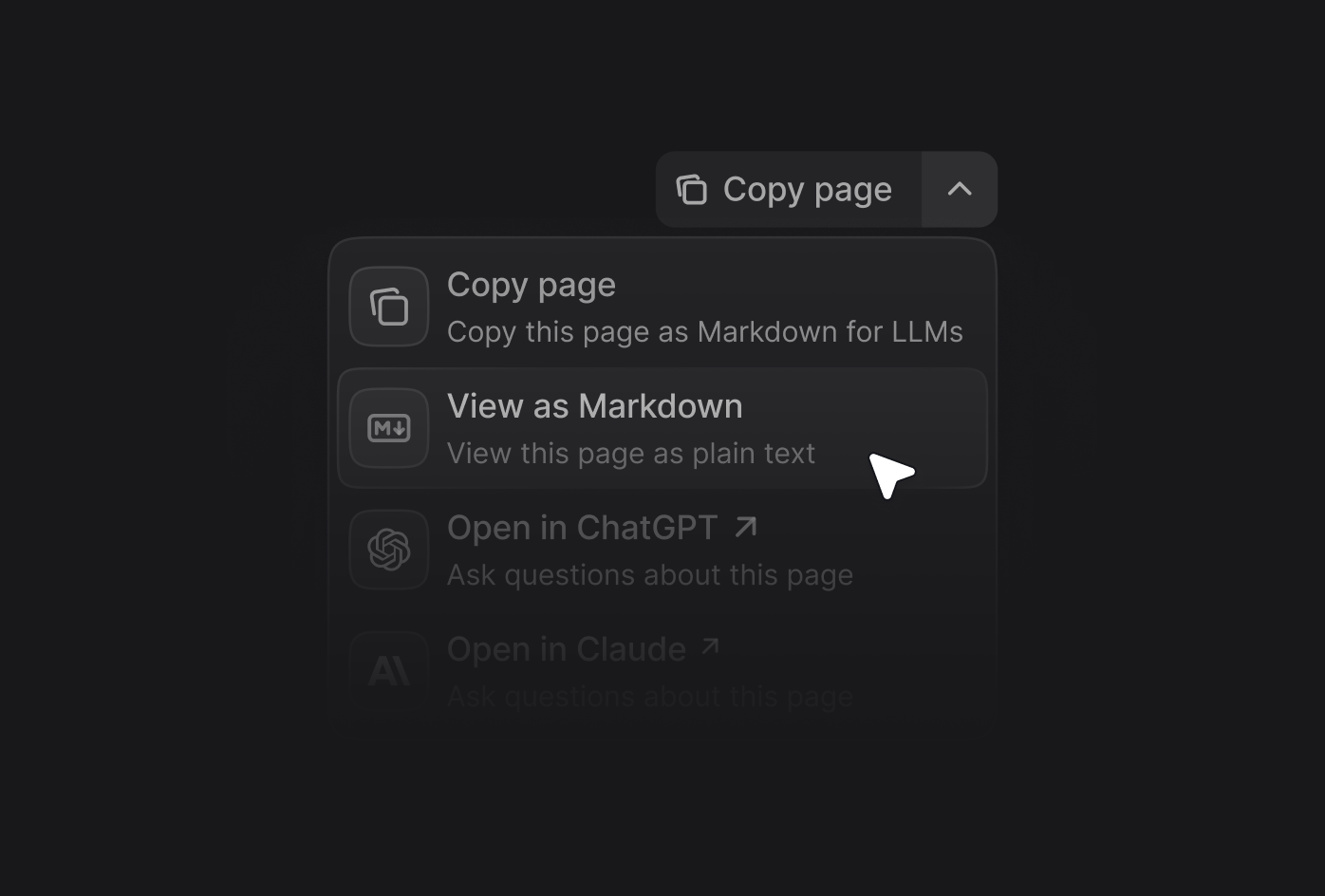
The contextual menu provides quick access to AI-optimized content and direct integrations with popular AI tools. When users select the contextual menu on any page, they can copy content as context for AI tools or open conversations in ChatGPT, Claude, Perplexity, or a custom tool of your choice with your documentation already loaded as context.
## Menu options
The contextual menu includes several pre-built options that you can enable by adding their identifier to your configuration.
| Option | Identifier | Description |
| :---------------------- | :----------- | :----------------------------------------------------------------------- |
| **Copy page** | `copy` | Copies the current page as Markdown for pasting as context into AI tools |
| **View as Markdown** | `view` | Opens the current page as Markdown |
| **Open in ChatGPT** | `chatgpt` | Creates a ChatGPT conversation with the current page as context |
| **Open in Claude** | `claude` | Creates a Claude conversation with the current page as context |
| **Open in Perplexity** | `perplexity` | Creates a Perplexity conversation with the current page as context |
| **Copy MCP server URL** | `mcp` | Copies your MCP server URL to the clipboard |
| **Connect to Cursor** | `cursor` | Installs your hosted MCP server in Cursor |
| **Connect to VS Code** | `vscode` | Installs your hosted MCP server in VS Code |
| **Custom options** | Object | Add custom options to the contextual menu |
## Enabling the contextual menu
Add the `contextual` field to your `docs.json` file and specify which options you want to include.
```json theme={null}
{
"contextual": {
"options": [
"copy",
"view",
"chatgpt",
"claude",
"perplexity",
"mcp",
"cursor",
"vscode"
]
}
}
```
## Adding custom options
Create custom options in the contextual menu by adding an object to the `options` array. Each custom option requires these properties:
The title of the option.
The description of the option. Displayed beneath the title when the contextual menu is expanded.
The icon to display.
Options:
* [Font Awesome icon](https://fontawesome.com/icons) name
* [Lucide icon](https://lucide.dev/icons) name
* JSX-compatible SVG code wrapped in curly braces
* URL to an externally hosted icon
* Path to an icon file in your project
For custom SVG icons:
1. Convert your SVG using the [SVGR converter](https://react-svgr.com/playground/).
2. Paste your SVG code into the SVG input field.
3. Copy the complete `` element from the JSX output field.
4. Wrap the JSX-compatible SVG code in curly braces: `icon={}`.
5. Adjust `height` and `width` as needed.
The [Font Awesome](https://fontawesome.com/icons) icon style. Only used with Font Awesome icons.
Options: `regular`, `solid`, `light`, `thin`, `sharp-solid`, `duotone`, `brands`.
The href of the option. Use a string for simple links or an object for dynamic links with query parameters.
The base URL for the option.
The query parameters for the option.
The query parameter key.
The query parameter value. We will replace the following placeholders with the corresponding values:
* Use `$page` to insert the current page content in Markdown.
* Use `$path` to insert the current page path.
* Use `$mcp` to insert the hosted MCP server URL.
Example custom option:
```json {9-14} wrap theme={null}
{
"contextual": {
"options": [
"copy",
"view",
"chatgpt",
"claude",
"perplexity",
{
"title": "Request a feature",
"description": "Join the discussion on GitHub to request a new feature",
"icon": "plus",
"href": "https://github.com/orgs/mintlify/discussions/categories/feature-requests"
}
]
}
}
```
### Custom option examples
```json theme={null}
{
"title": "Request a feature",
"description": "Join the discussion on GitHub",
"icon": "plus",
"href": "https://github.com/orgs/mintlify/discussions/categories/feature-requests"
}
```
```json theme={null}
{
"title": "Share on X",
"description": "Share this page on X",
"icon": "x",
"href": {
"base": "https://x.com/intent/tweet",
"query": [
{
"key": "text",
"value": "Check out this documentation: $page"
}
]
}
}
```
 ## Enabling the contextual menu
Add the `contextual` field to your `docs.json` file and specify which options you want to include.
```json theme={null}
{
"contextual": {
"options": [
"copy",
"view",
"chatgpt",
"claude",
"perplexity",
"mcp",
"cursor",
"vscode"
]
}
}
```
## Adding custom options
Create custom options in the contextual menu by adding an object to the `options` array. Each custom option requires these properties:
## Enabling the contextual menu
Add the `contextual` field to your `docs.json` file and specify which options you want to include.
```json theme={null}
{
"contextual": {
"options": [
"copy",
"view",
"chatgpt",
"claude",
"perplexity",
"mcp",
"cursor",
"vscode"
]
}
}
```
## Adding custom options
Create custom options in the contextual menu by adding an object to the `options` array. Each custom option requires these properties: